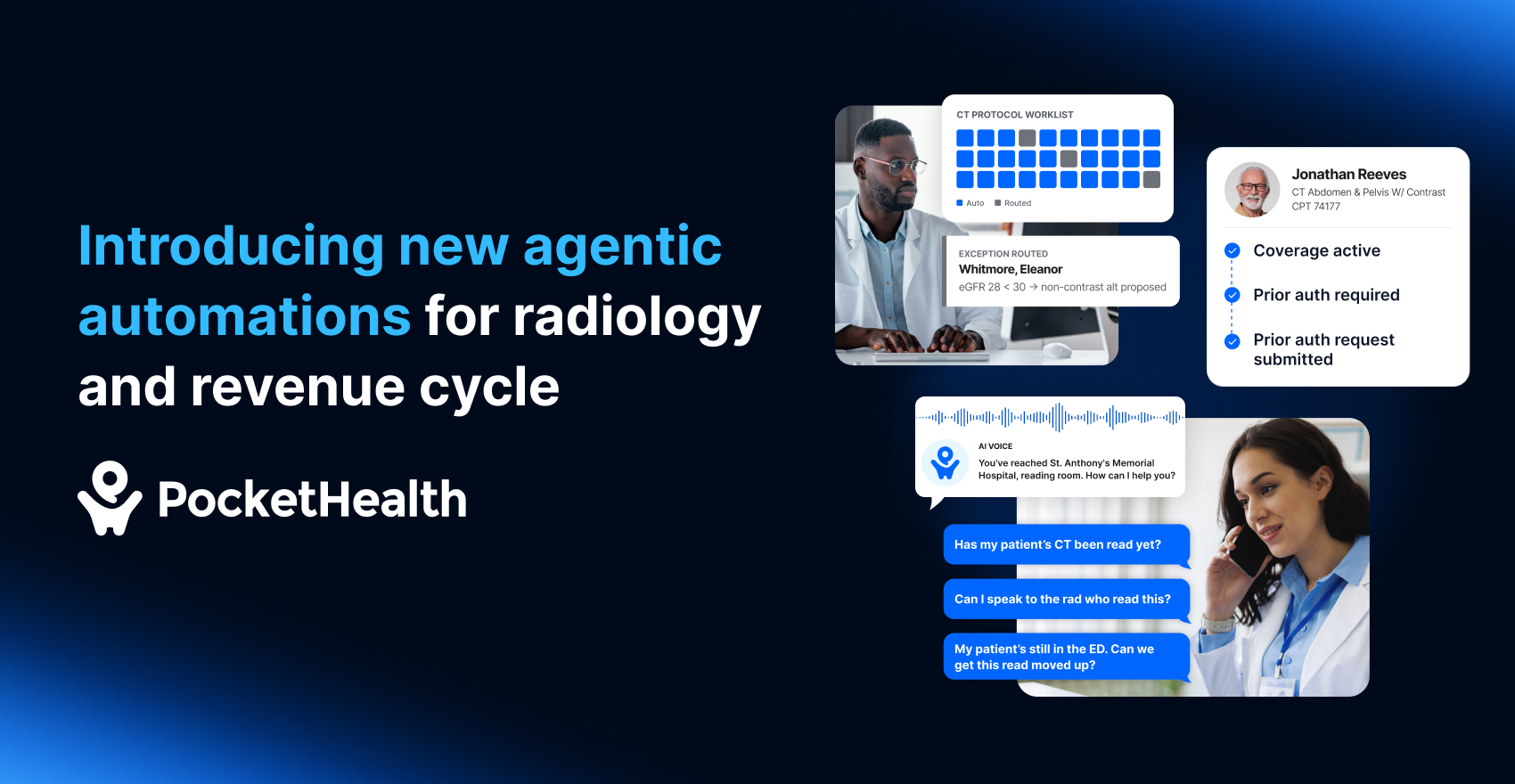
PocketHealth extends agentic automation into protocoling, reading room and revenue cycle
October 14, 2026
Read More
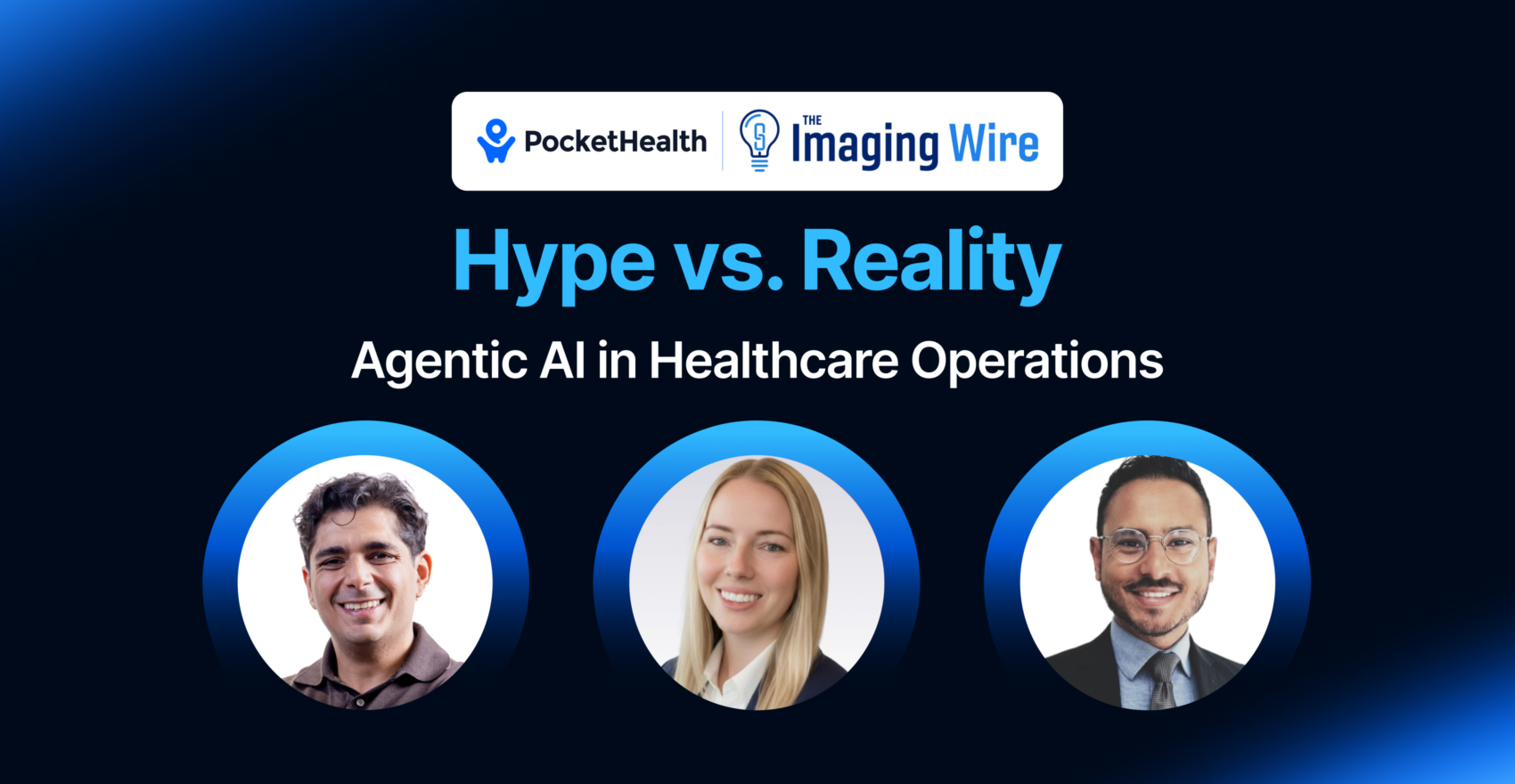
Agentic AI offers real relief for radiology teams facing rising referral volumes and roles they can’t staff, but the bar for success remains high. In the AuntMinnie webinar “Every Step Around the Exam: Agentic AI and the Radiology Department of the Future,” Stacie Barnard (Senior Director of Integrated Clinical Systems, University of Rochester Medicine), Michael Reinkober (CEO, Clear Medical Imaging) and Rishi Nayyar (Co-Founder and CEO, PocketHealth) shared the questions leaders should be asking vendors. The conversation was moderated by Allison Macleod, VP of Marketing at PocketHealth. Whether you’re heading to RSNA or starting vendor conversations of your own, this checklist will help you choose a partner ready to build your radiology department of the future.
Know what to measure today so you can compare results two and three months after go-live. “If you can’t show your KPIs, then what are we doing?” Stacie asked. Michael looks for real improvements in patient outcomes, which convince him far more than the projected efficiency gains vendors often present. Rishi added another early sign: clients start pushing to expand the rollout faster than the vendor does.
“What persuades me is I’ve just very simply seen an improvement in our patient outcomes. We’re able to book patients quicker. There are fewer patients that are dropping off the waitlist.”
Michael Reinkober, CEO, Clear Medical Imaging
Every vendor looks good in a sandbox, so Michael wants to see how a system performs alongside real staff. At Clear Medical Imaging, if a referral can’t move forward because of missing information, a low-confidence read or an unresponsive patient, the agentic operations platform hands it to staff with full context. Once the issue is resolved, the platform picks up where it left off, so nothing falls through the cracks. Ask vendors how staff can flag errors, what ongoing supervision will involve and how patients will know they’re speaking with AI. Stacie and Michael both disclose AI use to patients up front.
“You’re not only managing the hardware and the software around that AI, but you’re actually looking at how it’s functioning. It is truly like another human.”
Stacie Barnard, Senior Director of Integrated Clinical Systems, University of Rochester Medicine
Stacie’s starting point is simple: is this AI living within our four walls or is it leaving? If data leaves, ask where it’s processed, how it’s encrypted and whether any of it is stored in the vendor’s cloud afterward. Rishi also encourages leaders to ask vendors to explain how their cloud setup keeps your data separate and secure.
“What we’re really looking for on the security side is how are you protecting that data when I can’t?”
Stacie Barnard, Senior Director of Integrated Clinical Systems, University of Rochester Medicine
Very few tasks happen in a single window, so an agent needs to replicate every click a staff member makes, including in systems beyond the EHR and RIS. Ask how it will connect your best-of-breed systems and which parts of the solution are agentic versus traditional software. Rishi cautioned that AI making judgment calls shouldn’t have read and write access inside your EHR or RIS.
“Oftentimes integration is expensive and can be very painful. But working with these systems, they’ve really been able to natively interact with our systems. So it’s been seamless and it really does operate as another employee.”
Michael Reinkober, CEO, Clear Medical Imaging
Test a vendor’s operational knowledge with a scenario from your own department, like moving a PET-CT glucose check reminder to the night before. Then ask how the agent gets updated when your SOPs change, whether that’s a new mobile MRI site or a push to clear a referral backlog. As Rishi put it, specific examples reveal far more than open-ended questions about resilience. Be wary of a four-week implementation timeline too: capturing every edge case takes time.
“We call that flexibility and scalability, and if you don’t have that in a large academic medical centre, then we can’t play ball.”
Stacie Barnard, Senior Director of Integrated Clinical Systems, University of Rochester Medicine
Bring these questions to your next vendor conversation:
The technology is ready. Success now depends on finding a vendor that will collaborate deeply, answer these questions openly and adapt as your workflows evolve.
“The front door of radiology is going to be handled around the clock. Referrals aren’t going to sit on the fax machine to be actioned when somebody comes in. Healthcare doesn’t end.”
Michael Reinkober, CEO, Clear Medical Imaging
Hear more from Stacie, Michael and Rishi in the full conversation. Watch the full AuntMinnie webinar on demand here.
PocketHealth automates the operational complexity of healthcare: the manual, non-clinical work that surrounds every patient visit. For more than a decade, the company has automated this work from both the provider and patient sides, building a distinct understanding of how providers operate and how patients engage in their care. Its agentic operations platform extends that expertise across the enterprise, automating non-clinical workflows end-to-end while working inside existing systems and adapting to each site’s SOPs. The result for providers: improved capacity, financial performance and patient outcomes. PocketHealth is SOC 2 and HIPAA and PHIPA compliant, and trusted by 900+ health systems. Request a demo today.