Unlocking the Agentic AI Opportunity in Healthcare Operations
January 21, 2026
Read More
Radiology operations are a clear near-term opportunity for agentic AI deployment in healthcare. But there’s confusion about what agentic AI actually is and what it looks like in practice.
PocketHealth’s Co-Founder and CEO Rishi Nayyar and Co-Founder and CTO Harsh Nayyar addressed this in a recent webinar with The Imaging Wire. Here are six key takeaways from their discussion:
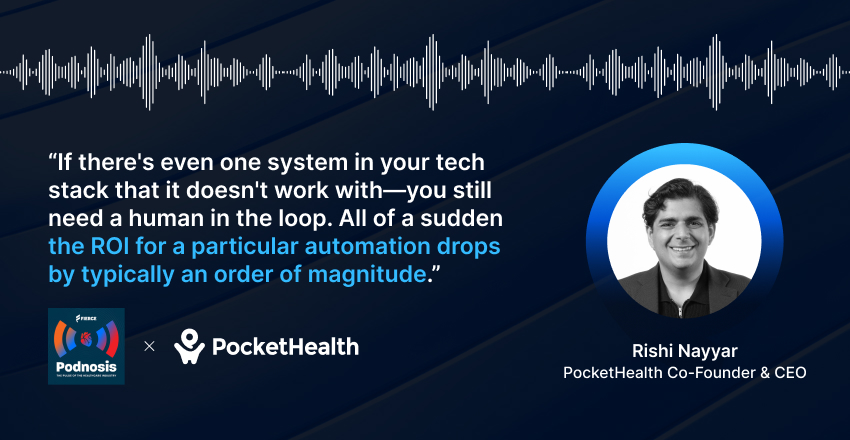
“It can actually work now. These foundational components are actually in place. That didn’t exist mid-2025.” (Rishi Nayyar)
Today’s agentic AI systems are not the same ones as 12 months ago. If your last evaluation of an agentic AI solution concluded “not ready,” it’s time to start back up that exploration.
“It takes actions. It doesn’t just produce outputs. It maintains a goal across a sequence of actions, across systems, across time, across different handoffs.” (Harsh Nayyar)
An agentic system holds a goal across an entire workflow — from referral intake through scheduling, prior auth and patient prep — acting autonomously and knowing exactly when to escalate, exactly as a human staff member would.
“The technology today can automate the entire patient intake function — the vast majority of clerical work in the overall workflow.” (Rishi Nayyar)
Order intake, completion checks, prior authorization, protocoling, scheduling, patient communications. The technology exists right now to automate every step — with human intervention reserved only for genuine exceptions.
“What EMRs or other broader enterprise systems aren’t as good at is doing end-to-end workflows, doing workflows that require a lot of nuance, a lot of configuration.” (Rishi Nayyar)
EMRs are systems of record. They can’t maintain memory across a multi-step process, handle exceptions gracefully or operate across the full landscape of systems a radiology department actually touches.
“The integration surface is the entire system — not just what the vendor had the foresight to expose via an API.” (Harsh Nayyar)
Agents can navigate a UI the way a human operator does, through local applications and web-based platforms. The integration surface is the entire system, not just what a vendor exposed in an API.
“A system that always answers ‘yes, I can do it’ is actually hiding its uncertainty rather than surfacing it.” (Harsh Nayyar)
A system that always says “yes, I can do it” is hiding uncertainty. The agents worth deploying behave like your best teammates: they know when a situation needs a human and they escalate with full context.
Agentic AI in radiology operations isn’t a distant possibility — it’s a decision that’s already in front of healthcare operations leaders. This webinar discussion goes even deeper into the operational realities of agentic AI deployments, including accuracy rates, guardrails, escalation paths and where to get started first.
Book a demo with our team here.