


Every referral, payer check, patient call and follow-up that requires staff to work across multiple systems adds to a growing coordination burden. Much of that work still depends on staff manually moving information, leading health systems to ask: why can’t our EHR just do this?
A system of coordination handles the multi-step work that moves across different systems (the EHR, RIS, PACS, fax and telephony systems and external portals). It manages workflows that can span weeks or even months, maintaining memory and state from one step to the next. It completes that work end to end without human intervention and when it encounters uncertainty, it fails gracefully by pausing and routing the task to the right person.
The EHR plays a different role. It’s the system of record: the trusted home for each patient’s record, including their orders, appointments and results. EHRs were designed to be systems of record, so orchestrating multi-step workflows across multiple systems falls outside what they were built for. Much of the work that needs to be automated also happens beyond the EHR’s walls.
Instead, providers should be asking: what should the interaction model be between a system of coordination and my EHR? The answer is that a system of coordination should work in the EHR the way trained staff do. It follows the same rules and writes every result back. It also brings work that happens outside the EHR’s walls (faxed referrals, payer approvals and patient calls) into the system of record. That way, the EHR keeps its role as the single source of truth.
Watch PocketHealth Co-Founder and CTO Harsh Nayyar share his full perspective on this topic.
Book a demo to talk to our team about how agentic AI works with your EHR.
To see how this works, here’s one example: an imaging workflow at a large health system running on a major EHR platform, from the moment a referral arrives to the moment the patient shows up prepared for their appointment.
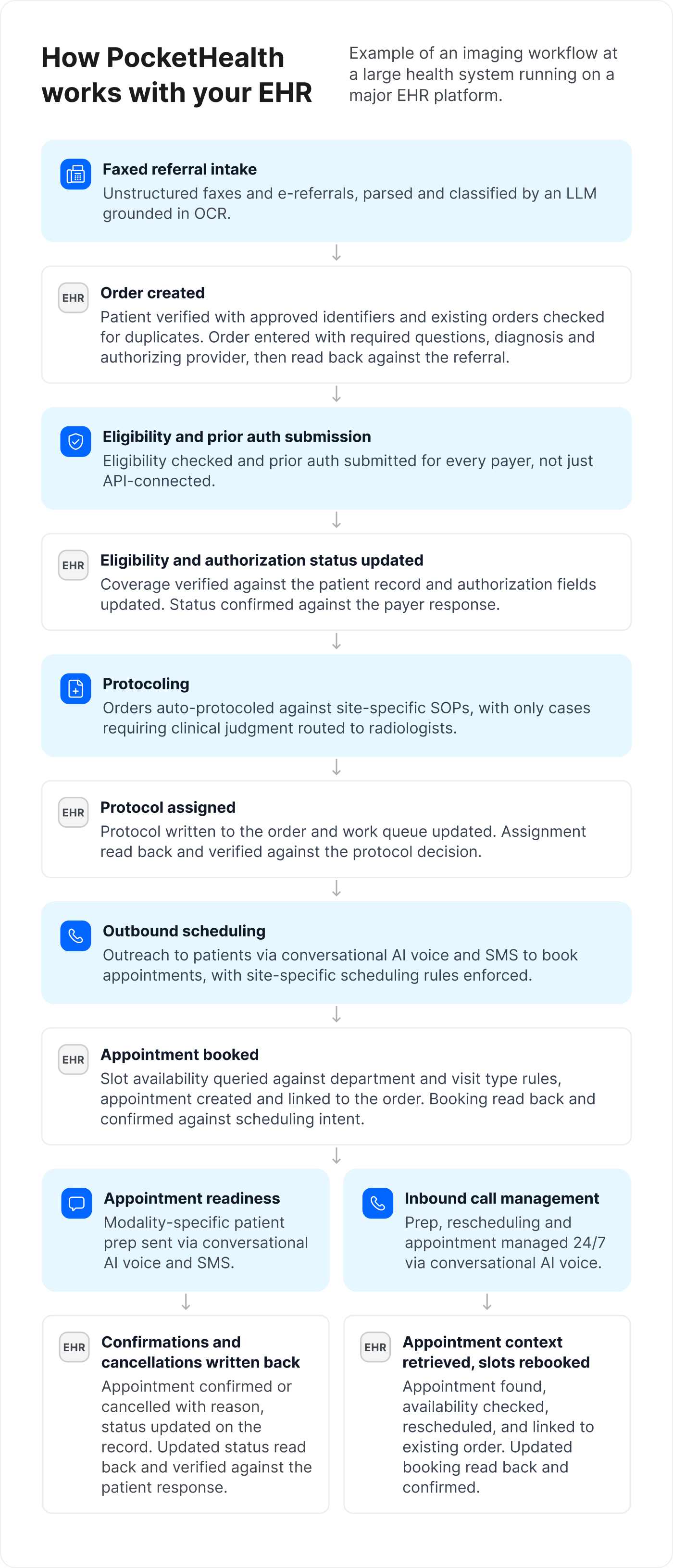
A system of coordination at work: each step across fax, portals, voice and SMS is written back to the EHR and verified.
PocketHealth operates in your EHR like a new clerical staff member on day one: Through a purpose-scoped account your team provisions, with access to exactly what the job requires. It follows your SOPs, using the same steps your staff do. When something falls outside the routine, it escalates through the process you’ve agreed on.
PocketHealth helps you get more from the EHR you already pay for. It automates the manual work your staff do in the EHR every day, such as creating orders, booking appointments and tracking authorizations, so your teams gain capacity. With pricing tied only to successful automations, it’s a risk-free way to build on your investment.
Whatever your EHR roadmap looks like, there will always be manual work outside the EHR’s network, from faxes to external portals to phone calls, that drains capacity and budgets. PocketHealth is designed to absorb that work. With implementation in weeks and outcome-based pricing, it’s a low-risk way to start relieving that pressure now.
PocketHealth is one agentic operations platform that can automate any non-clinical workflow across your health system. You procure it once, with unlimited configurations and automations, so each new workflow is added within the same platform. Many teams start in radiology and expand from there, consolidating the separate tools they use for fax processing, outreach and prior authorization.
The EHR will remain the foundation of healthcare operations. As the coordination work around it grows, an agentic operations platform gives teams a sustainable way to keep up, with more time for the work that needs their expertise and care.
Book a demo to see how PocketHealth works alongside your EHR.
PocketHealth automates the operational complexity of healthcare: the manual, non-clinical work that surrounds every patient visit. For more than a decade, the company has automated this work from both the provider and patient sides, building a distinct understanding of how providers operate and how patients engage in their care. Its agentic operations platform extends that expertise across the enterprise, automating non-clinical workflows end-to-end while working inside existing systems and adapting to each site’s SOPs. The result for providers: improved capacity, financial performance and patient outcomes. PocketHealth is SOC 2 and HIPAA and PHIPA compliant, and trusted by 900+ health systems. Request a demo today.

